

March 8–14, World Glaucoma week – Preventive screening saves sight
Prevention and early diagnosis are the only “weapons” against a disease expected to threaten the vision of more than 110 million people by 2040.
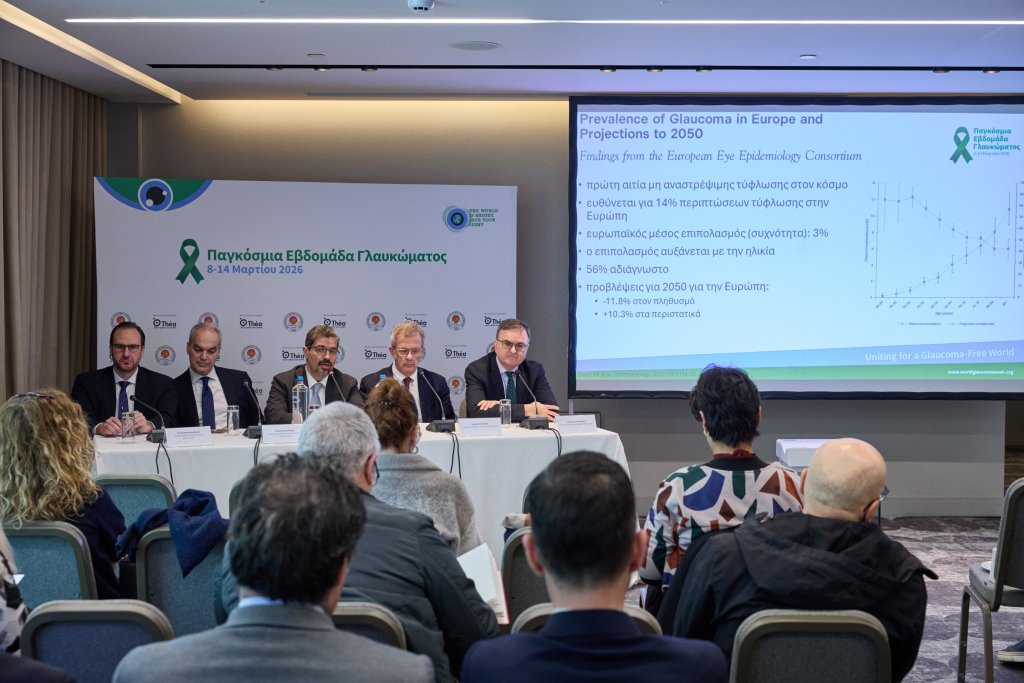
On the occasion of World Glaucoma Week (March 8–14) and with the primary objective of informing and raising awareness among the wider public about glaucoma, its symptoms, prevention and management, the Hellenic Glaucoma Society held a press conference today, presenting data and scientific evidence regarding glaucoma as well as the ways to prevent and manage the disease.
The discussion during the event was moderated by Mr. Ioannis Chalkiadakis, NHS Director, 1st Department of Ophthalmology, Glaucoma Unit, Athens Eye Hospital, Athens (President of the Hellenic Glaucoma Society).
The speakers included:
- Fotis Topouzis, Professor of Ophthalmology, Director of the 1st Department of Ophthalmology, Aristotle University of Thessaloniki, AHEPA University Hospital, Thessaloniki (President of the World Glaucoma Association, former President of the European Glaucoma Society, former President of the Hellenic Glaucoma Society and Board Member of the HGS)
- Stylianos Kandarakis, Ophthalmic Surgeon, Assistant Professor of Ophthalmology, National and Kapodistrian University of Athens, 1st University Department of Ophthalmology, G. Gennimatas Hospital (Vice President, Hellenic Glaucoma Society)
- Efthymios Karmiris, Ophthalmic Surgeon, Assistant Professor of Ophthalmology, National and Kapodistrian University of Athens, 2nd University Department of Ophthalmology, G. Gennimatas Hospital (Secretary General, Hellenic Glaucoma Society)
- Theodoros Filippopoulos, Ophthalmic Surgeon, Scientific Director, Athens Vision Eye Institute, Athens (Special Secretary, Hellenic Glaucoma Society)
Within the framework of World Glaucoma Week, the press conference focused on key information pillars regarding the disease and the importance of early diagnosis. Specifically:
- Dr. Filippopoulos presented what glaucoma is and how it gradually affects vision, highlighting its silent and often undiagnosed nature.
- Prof. Topouzis referred to the purpose of establishing World Glaucoma Week by the World Glaucoma Association and presented the latest Greek data reflecting the extent of the disease in Greece.
- Dr. Karmiris focused on current recommendations for early diagnosis, emphasizing the role of regular ophthalmological examinations.
- Dr. Kandarakis analyzed the available therapeutic options for patients, explaining how glaucoma is treated in modern clinical practice.
World Glaucoma Week (WGW) is a global initiative organized by the World Glaucoma Association since 2008, aiming to raise awareness about glaucoma and prevent blindness caused by the disease.
Each year, hundreds of awareness activities take place worldwide during World Glaucoma Week with the collaboration of patients, healthcare professionals, health organizations and the general public, aiming to promote prevention and awareness.
Glaucoma, A Silent Threat to Vision
Glaucoma is the leading cause of irreversible blindness worldwide, yet it remains largely undiagnosed because it usually develops without symptoms in its early stages. Most patients are unaware they have the disease until significant vision damage has already occurred. For this reason, regular eye examinations are crucial, particularly after the age of 40–45. Because glaucoma progresses silently and often remains undetected in its early stages, many patients lose part of their vision before realizing they are at risk. Awareness and regular screening are the only reliable means of prevention — eye examinations are recommended every two years before the age of 40 and annually thereafter.Early diagnosis can prevent the severe impact that advanced disease may have on daily life and quality of life.
Glaucoma Prevalence
The prevalence of glaucoma reaches 2.5% among individuals over the age of 45, increasing with age. In Greece, according to data from the Thessaloniki Eye Study—a major epidemiological study of eye diseases with international recognition—the prevalence reaches 5.5% among individuals over the age of 60. Based on population data, it is estimated that approximately 170,000 Greeks over the age of 60 suffer from glaucoma, while 50% of them (around 85,000 individuals) remain undiagnosed. Regular ophthalmological examinations help ensure early diagnosis. In particular, according to the Thessaloniki Eye Study, patients who had not been examined by an ophthalmologist within the past year were six times more likely to remain undiagnosed.
What We Should Know About Glaucoma
Glaucoma is a disease that develops insidiously, usually without symptoms in its early stages, and is the most common cause of irreversible blindness worldwide. Because of its characteristics, it is often referred to as “the silent thief of sight.” Prevention and early diagnosis are therefore the only effective ways to significantly reduce the risk of vision loss. This is the central message of World Glaucoma Week, March 8–14. Glaucoma is a group of eye diseases that cause progressive damage to the optic nerve, often due to increased intraocular pressure (IOP). According to data from the World Glaucoma Association, more than 50% of patients are unaware they have glaucoma until significant vision loss occursThe disease represents a major global health challenge: in 2020, approximately 76 million people were living with glaucoma, while this number is expected to exceed 110 million by 2040. More recent projections estimate that the number of people with open-angle glaucoma will increase from 81 million in 2024 to 185 million by 2060, largely due to population aging and the increasing prevalence of myopia.
Higher Risk Groups
Individuals at higher risk include:
- Older adults, particularly after the age of 60
- Individuals with family history of glaucoma, whose risk is 4–10 times higher
- Individuals with high myopia, which is expected to contribute to approximately 35 million new glaucoma cases by 2060
- Individuals of African or Asian descent, where glaucoma occurs more frequently
- Corticosteroid users, especially those using ophthalmic eye drops that may increase intraocular pressure
Symptoms and Impact on Daily Life
In its early stages, glaucoma does not cause noticeable symptoms.
Many patients realize the problem only when peripheral vision begins to deteriorate, vision becomes blurred or dim, and difficulties arise in driving, reading or seeing in low-light conditions.
As the disease progresses, it can significantly affect daily life, including:
- driving, walking and judging distances
- night vision and adaptation to bright or low light
- increased risk of falls and accidents
- mental health, including anxiety and depression affecting up to 30% of patients
Early Diagnosis is Key
Modern ophthalmology now offers highly accurate diagnostic tools that allow early detection before significant vision loss occurs. These include:
- measurement of intraocular pressure (tonometry)
- optic nerve examination
- Optical Coherence Tomography (OCT) for retinal nerve fiber imaging
- visual field testing
- gonioscopy
Screening frequency depends on age:
- Under 40: low prevalence in the general population, but screening may be recommended for individuals with family history
- Over 40: eye examination every two years regardless of family history
- Over 60: annual examination is recommended
Is There Treatment?
Glaucoma cannot be cured, but it can be effectively controlled, primarily by lowering intraocular pressure and slowing disease progression.
Treatment options include:
Medication (eye drops)
Eye drops reduce intraocular pressure by either increasing the outflow of aqueous humor or decreasing its production and remain the first-line treatment.
Laser – Selective Laser Trabeculoplasty (SLT)
Studies show that SLT can effectively control intraocular pressure in selected patient groups, reducing the need for medication and surgery.
Surgical treatment
When necessary, procedures such as minimally invasive glaucoma surgery (MIGS), trabeculectomy, or valve implantation may be performed. Surgical management remains an option particularly in advanced cases.
Awareness and Prevention Recommendations
On the occasion of World Glaucoma Week, the Hellenic Glaucoma Society encourages the public to:
- Have regular eye examinations, even in the absence of symptoms
- Inform family members if diagnosed with glaucoma, as first-degree relatives have significantly higher risk
- Strictly adhere to prescribed treatment, as non-compliance is a major cause of vision loss
- Contact an ophthalmologist if eye drops cause discomfort, for example due to preservatives
- Avoid using corticosteroid eye drops without medical supervision
Statements by the Speakers
Dr. Theodoros Filippopoulos, Special Secretary of the Hellenic Glaucoma Society, stated:
“Despite the significant scientific advances that have been achieved both in the diagnosis and monitoring of glaucoma as well as in its treatment, disability and blindness rates due to glaucoma remain high and are even increasing due to demographic ageing in Western societies. This is largely attributed to the still high percentage of patients who remain undiagnosed, as the disease progresses slowly and is asymptomatic in its early stages, as well as to the often inadequate adherence of patients to medical recommendations. As a chronic degenerative disease, glaucoma challenges health systems but also society as a whole, since its management requires accessibility to healthcare services, pharmaceutical and surgical treatment, as well as humanity and empathy from healthcare providers and support for patients from both their families and the wider community.”
Professor Fotis Topouzis, President of the World Glaucoma Association, noted:
“The prevalence of glaucoma reaches approximately 2.5% among individuals over the age of 45 and increases with age. In Greece, according to data from the Thessaloniki Eye Study a large epidemiological study of ophthalmic diseases with international recognition — the prevalence reaches 5.5% among individuals over the age of 60.Based on population data, it is estimated that approximately 170,000 Greeks over the age of 60 suffer from glaucoma, while 50% of them — around 85,000 people — remain undiagnosed. Regular ophthalmological examinations help ensure early diagnosis. In particular, according to the Thessaloniki Eye Study, patients who had not been examined by an ophthalmologist within the past year had a six-fold higher risk of remaining undiagnosed.”
Dr. Efthymios Karmiris, Secretary General of the Hellenic Glaucoma Society, stated:
“Glaucoma does not hurt and it does not warn. It simply steals vision silently. Do not let it blind you through neglect.It is a disease that remains largely invisible and progresses silently without symptoms, affecting one in two unsuspecting patients. The greatest problem is not the disease itself, but the lack of awareness surrounding it. Patients lose an irreversible part of their vision before they have the chance to react, simply because they are unaware they are at risk.Awareness and regular eye examinations are the only defense. Early diagnosis is the only shield against irreversible vision loss. The rule of prevention is simple: an eye examination every two years after the age of 40 and every year after the age of 60. When glaucoma reaches an advanced stage, the impact on quality of life can be dramatic: depression, social isolation, loss of the ability to drive and increased risk of falls and fractures. Do not wait until you lose your sight. Glaucoma shows no signs… until it is too late.”
Dr. Stylianos Kandarakis, Vice President of the Hellenic Glaucoma Society, stated:
“Glaucoma cannot be cured, but it can be effectively controlled when diagnosed early and properly treated. The first line of treatment usually consists of eye drops that reduce intraocular pressure either by limiting the production of aqueous humor or by improving its drainage. In selected patient groups, Selective Laser Trabeculoplasty (SLT) has demonstrated high effectiveness and can also serve as a first-line treatment option.When intraocular pressure cannot be controlled with eye drops or SLT, surgical solutions such as trabeculectomy, valve implantation or more modern minimally invasive glaucoma surgery (MIGS) procedures may be required, which are now also available in Greece. Proper patient education and close collaboration with the ophthalmologist are crucial for the long-term management of glaucoma. Regular eye examinations are necessary even in the absence of symptoms. In cases of diagnosis, first-degree family members should also be informed, as they face a significantly increased risk. Strict adherence to treatment remains the most important factor in preserving vision. If eye drops cause discomfort, for example due to preservatives, patients should consult their ophthalmologist to adjust their treatment. Finally, corticosteroid eye drops should not be used without medical supervision, as this may be dangerous.”
Dr. Ioannis Chalkiadakis, President of the Hellenic Glaucoma Society and moderator of the press conference, emphasized:
“Since we cannot cure the blindness caused by glaucoma, our mission is to prevent it by diagnosing and treating the disease in its early stages. This is particularly important in the Greek population, where pseudoexfoliative glaucoma is relatively common — a type of glaucoma that can lead to rapid blindness if left untreated.”
Lighting of the Hellenic Parliament
On Tuesday, March 10, between 20:00 and 22:00, part of the façade of the Hellenic Parliament building (the left side when facing the building from Syntagma Square) will be illuminated in green, the color symbolizing World Glaucoma Week.This initiative is undertaken by the Hellenic Glaucoma Society as part of public awareness activities about glaucoma.

With the kind support of Théa Pharma Hellas
With 150 years of history in ophthalmology, Théa has made a significant contribution to research, innovation and the development of new therapeutic solutions. With roots dating back to the 19th century and founded on the heritage of the Chibret family, the company remains committed to advancing European ophthalmology by passing knowledge and expertise from generation to generation. Today, Théa continues to evolve with consistency and vision, respecting its history while focusing firmly on the future. With a strong commitment to quality, scientific progress and support for the ophthalmic community, the company actively contributes to initiatives that promote awareness and prevention of eye diseases.